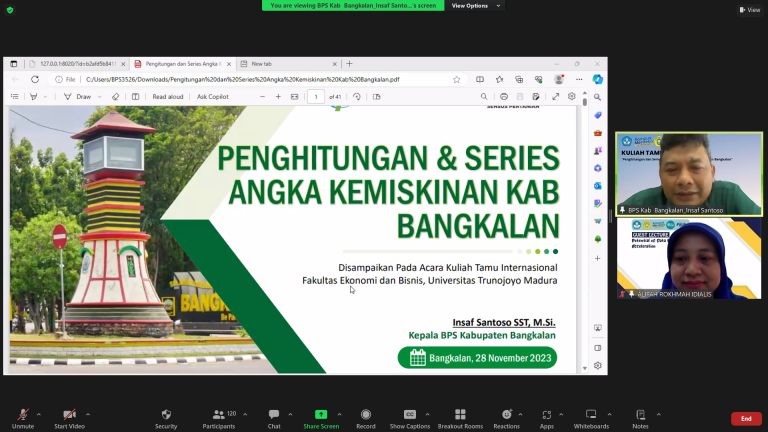
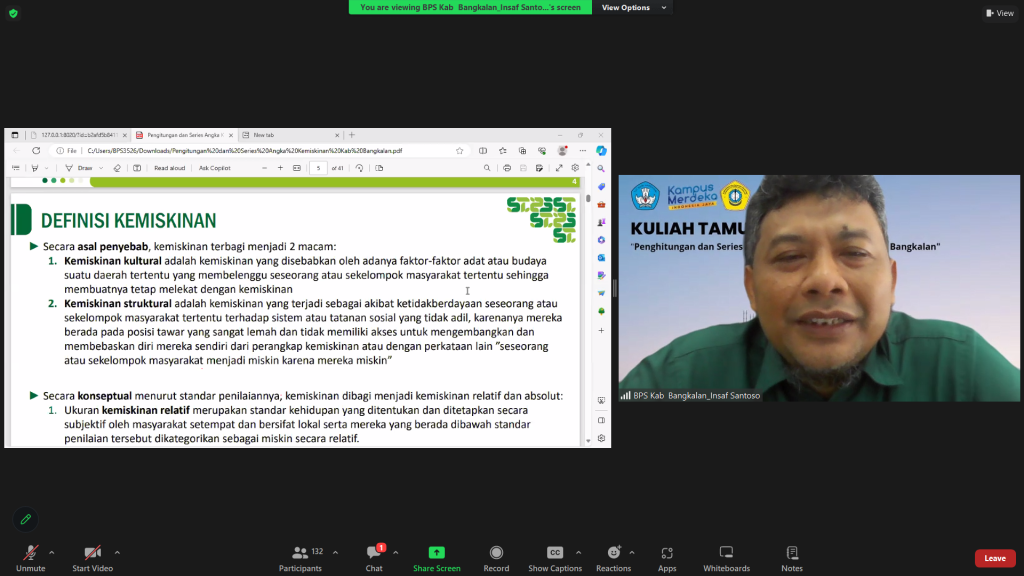
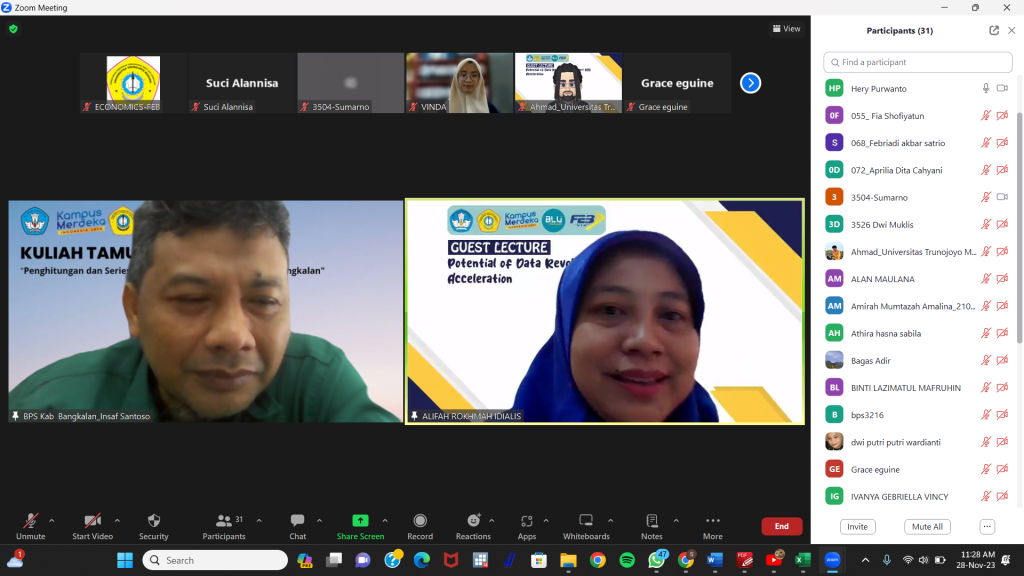
On Tuesday, November 28, 2023, the Development Economics Studies Program held a national guest lecture on the theme “Calculation and series of poverty figures in Bangkalan district”. This activity aims to provide knowledge and understanding to students, faculty, and society about concepts, methods, and results of the poverty figure calculation in Bangkok district, which is one of the areas with the highest poverty rates in East Java.
This national guest school is presented by a specialist and experienced researcher in his field, namely Insaf Santoso, S.ST, M.Si., who serves as Head of the Central Statistical Agency (BPS) of Bangkalan district. He is an alumni of the statistical major of the Ten Nopember Institute of Technology (ITS) Surabaya, who then continued his master’s studies in applied statistics at Gadjah Mada University. He also has experience as staff, sex head, and head of field in various BPS work units, both at the central and regional level.
The moderator who guided the course of this national guest lecture is Alifah Rokhmah Idialis, SE., M. Sc., who is a young lecturer and secretary of the major economics of UTM. He is also active in research, dedication, and development of economics, especially in the field of development economics, regional economics and environmental economics.
This national guest lecture was followed by about 200 participants, consisting of students, lecturers, and the general public, both online and online. The event lasted two hours, in a presentation, discussion, and question-and-answer format. In his presentation, Insaf Santoso explained the definitions, dimensions, indicators, and measurements of poverty, as well as the challenges and problems faced in calculating poverty figures. He also presented about data, sources, and processing of data on poverty and the methodologies and formulas used to calculate the poverty line, the number of poor population, poverty depth index, and poverty severity index. He also presented and analyzed a series of poverty figures in Bangkalan district, both temporally and spatially, as well as factors that influence poverty levels in the area.
During the discussion and questioning sessions, participants were very enthusiastic and active in asking questions, comments, and suggestions related to the submitted material. Some of the questions raised include the validity, reliability, and accuracy of poverty data, the impact of the Covid-19 pandemic on poverty, government strategies and policies in poverty reduction, and the role and contribution of academics and the community in reducing poverty. Insaf Santoso answers these questions in a clear, detailed, and informative manner, as well as providing real examples and relevant latest data. He also appreciated and responded to the suggestions given by the participants positively and openly.
This national guest lecture ended with a word of thanks for his readiness and contribution as a guardian. Furthermore, the moderator concluded the event by conveying conclusions and important messages from the submitted material, as well as inviting the participants to continue learning and developing the science of economics, especially the economy of development, which is beneficial to the society and the nation.