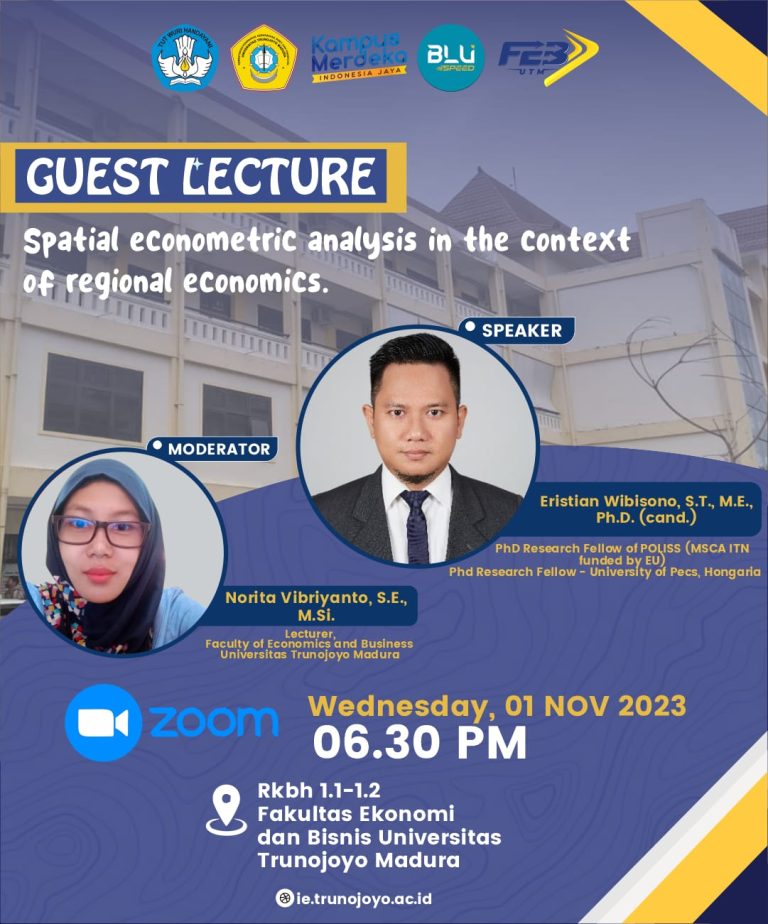


On Wednesday, November 1, 2023, from 18.30 to 20.30 p.m., the International Guest Course will be held hybridly through the zoom meeting and the University of Trunojoyo Madura RKBH FEB room. The theme of the guest lecture is “Spatial Econometric Analysis in the Context of Regional Economics”. Spatial econometric analysis is a method of data analysis that takes into account spatial or geographical aspects of the relationship between economic variables. This method can be used to test hypotheses, estimate parameters, and predict regional economic phenomena, such as economic growth, income disparities, convergence, agglomeration, and so on.
The guest speaker is Eristian Wibisono, Ph.D., a lecturer and researcher in regional economics at Policies for Smart Specialisation (Poliss). Eristian holds a Master’s degree in Economics from Jambi University (Indonesia). He is currently working as a civil public official in the Department of Industry and Trade in the province of Jambi, Indonesia. He began his teaching experience as a guest lecturer at the University of Jambi’s Chemical Studies Program. His research interests are Development Economics, Regional Economics and Industrialization where he has published several related scientific papers. The guest lecturer is Norita Vibriyanto, M.Si, a lecturer and researcher in the field of regional economics at FEB Trunojoyo Madura University.
The guest lectures were attended by students of the 3rd and 4th semesters of FEB University of Trunojoyo Madura Economics Development, as well as several lecturers who were interested in the guest lecture topic. The number of participants who attended guests lectures online through zoom meetings was less than 150 people, while those who followed offline in the FEB RKBH room of the University of trunojojoyo madura was about 50 students.
The guest lectures submitted by the source include the following:
Spatial econometric analysis, such as spatial lag model,spatial error model, spasial Durbin model, and spatiale panel model. Techniques of estimation and inference of spacial economic analysis such as maximum likelihood, generalized method of moments, instrumental variables, and space two-stage least squares. Technical specification and diagnostics of space econometrics such as Moran’s I, Lagrange multiplier, Anselin-Kelejian, and robustness check. Examples of case studies using space economic analysis include studies of the influence of infrastructure on regional economic growth in Indonesia, studies of inter-provincial income convergence in Indonesia and studies of industrial agglomeration in East Java.