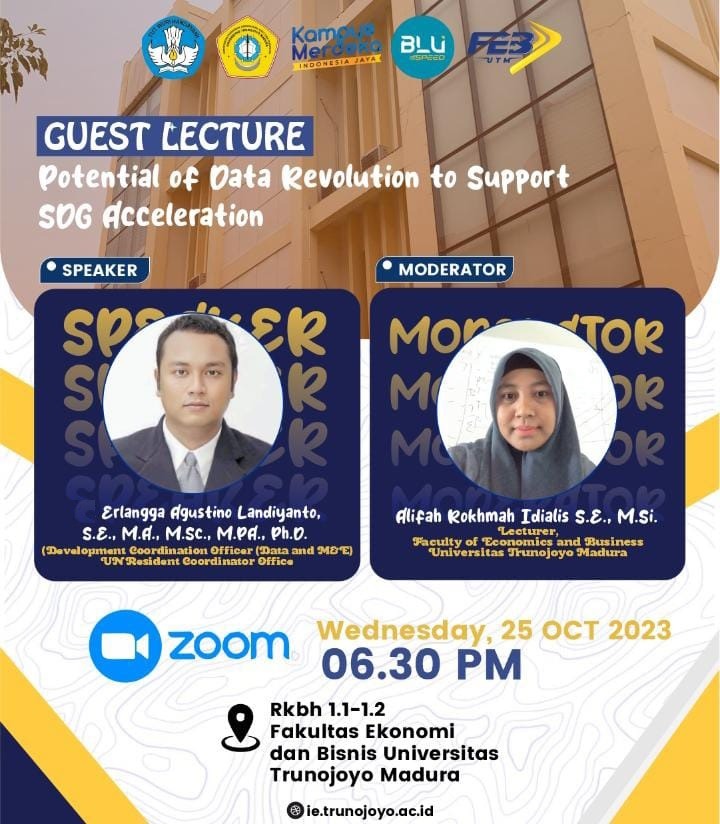


FEB University of Trunojoyo Madura is one of the academic activities aimed at improving the insight and competence of students and lecturers in the field of Development Economics. The event will take place on Wednesday, October 25, 2023, at 18.30 – 20.30 PM, hybridly through the zoom meeting and the RKBH FEB of the University of Trunojoyo Madura.
The theme of the guest lecture is “Potential of Data Revolution to Support SDG’s Acceleration”. Data revolution is a term that describes rapid developments and transformations in the production, processing, storage, analysis, and use of data in a variety of fields, including the development economy. data revolution can provide opportunities and challenges for achieving the Sustainable Development Goals (SDGs), the 17 global goals agreed by the United Nations to create a better and more sustainable world by 2030.
The guest speaker is Erlangga Agustino Landiyanto, Ph.D., a Development Coordination Officer (Data M&E) at United Nations Indonesia. Erlangga is an Indonesian citizen who has been working as a public policy practitioner as well as monitoring and evaluation since 2005. He completed his PhD in Social Policy from the University of Bristol, England. He also holds three master’s degrees: Master of Art from Mahidol University, Thailand; Master of Science in Evaluation and Development Management from the University of Antwerp, Belgium; and Master of Public Administration from University of York, England; and a Bachelor of Economics from Airlangga University. Erlangga has worked with various institutions such as ASEAN Secretariat, BAPPENAS, American Red Cross, Echo Mobile, UNICEF, World Bank, UNORC, IFC and Care International. He is also a member of several associations such as the INDEC (Indonesian Development Evaluation Community), the Indonesian Regional Science Association (IRSA), the Social Policy Association, and the HDCA. (Human Development and Capability Association).
The guest lecturer is Alifah Rokhmah Idialis, M.Sc, a lecturer and researcher in the field of development economics at FEB University of Trunojoyo Madura.
The guest lectures were attended by students of semester 1, 3, and 5 of FEB University of Trunojoyo Madura Economics Development, as well as several lecturers. The number of participants who attended the guest lecture online through the zoom meeting was about 150 people, while those who followed offline in the FEB RKBH room of the University of trunojojoyo madura was about 60 people.
The guest lectures submitted by the source include the following:
- The understanding, characteristics, and impact of data revolution in the context of the development economy
- Types of data that are relevant and essential to support the achievement of the SDGs, such as administrative data, survey data, census data, satellite data, big data, and open data
- Data collection, processing, analysis, and visualization techniques that can be used to measure, monitor, and evaluate the progress of SDGs, such as data dashboards, data portals, data mapping, data storytelling, and data analytics.
- Examples of initiatives and good practices taken by the United Nations, government, private, academics, and civil society in using data revolution to support SDGs, such as SDG’s Indonesia One Data, SDG’s National Action Plan, SD G’s Voluntary National Review, SD g’s Academy, and SD G’s Solutions Network
The results of the international guest lectures of the development economy are as follows:
- Participants can understand and apply the concepts, principles, and impact of data revolution in the context of the development economy
- Participants can develop knowledge and skills in using relevant and critical data to support the achievement of the SDGs
- Participants can identify and solve issues related to data revolution, such as data quality, data access, data collaboration, and data ethics
- Participants can produce qualified and relevant scientific papers using revolution data, such as dissertations, theses, journals, seminar papers, etc.
The international guest lectures at the University of Trunojoyo Madura are expected to be beneficial to the development of the science of development economics at the FEB. By presenting competent and experienced sources in the field of data revolution, it is expected that students and lecturers of development economics can improve their insights and competences in using accurate, valid, and reliable data to support the achievement of the SDGs. Thus, students and professors of development economy can produce quality scientific work and relevant to the current development of development economic science.