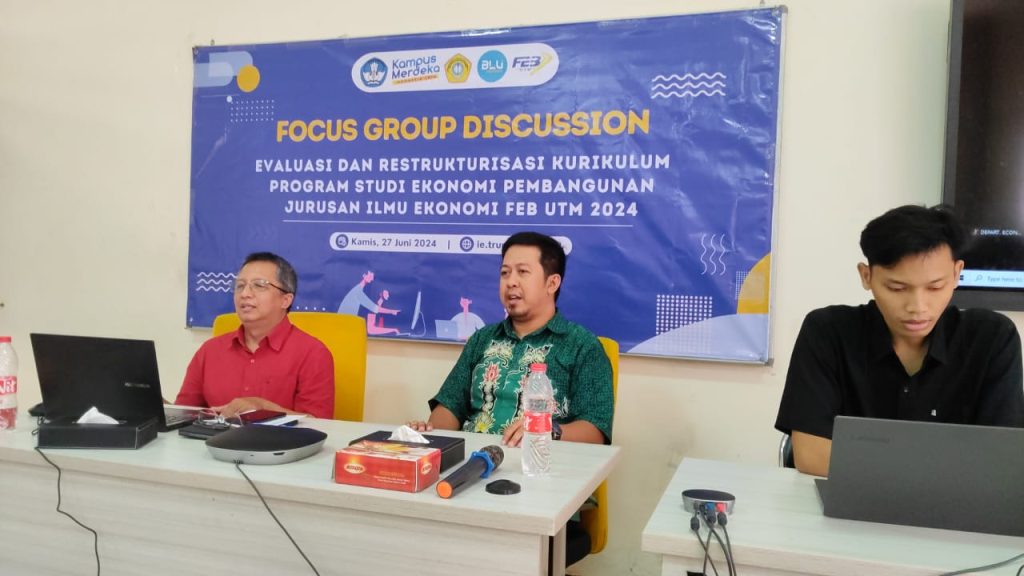

The Development Economics Study Program, Department of Economics, Trunojoyo University Madura, successfully held a Forum Group Discussion (FGD) entitled “Curriculum Evaluation and restructuring”. This activity was carried out in a hybrid manner, utilizing the Zoom Meeting platform and took place in rooms 1.1 and 1.2 of the RKBH FEB Building, with two sessions taking place at 09.00 and 13.00.
This FGD presented a number of resource persons who have extensive competence and experience in the field of development planning. The main speakers included Dr. Fajri Muharja, S.E., M.Si., who served as Chair of the Department of Economics FEB Andalas University and also as Chair of the Association of Indonesian Development Economics Study Programs (APSEPI). He discussed the importance of accurate data and in-depth analysis in formulating effective development policies.
In addition, Dr. (Cand) Lutfi Firdausi, M.Pd., as Director of the Indonesian Educational Innovation Training and Consultant Institute (LPKIPI), shared his experience on how innovation in education can influence development planning in the regions. Lutfi emphasized that quality education is the foundation for producing human resources capable of planning and implementing development effectively.
Rizki Okta from the Regional Planning and Development Agency of Bojonegoro Regency was also present as a resource person. Rizki explained about the challenges and opportunities faced in regional development planning, as well as the importance of collaboration between local government and community in developing relevant programs. Rizka Fristiani from CV Inti Desain Ekonomi (IDE) Consultant added a perspective from the private sector on how the sector can contribute to sustainable development.
One of the important topics discussed in this FGD was the evaluation and restructuring of the curriculum in the Development Economics Study Program. The resource persons and discussion participants underlined that an adaptive and relevant curriculum is needed to face dynamic development challenges. Evaluation of the existing curriculum is carried out by considering the needs of industry and society, so that graduates can have skills that are in accordance with the demands of the times.
In this discussion, Dr. Fajri Muharja emphasized that the curriculum should integrate practical elements, such as case studies and field projects, to give students hands-on experience in development planning and implementation. Dr. (Cand) Lutfi Firdausi added the importance of including material on innovation and technology in the curriculum so that students can adapt to the latest developments in the field of development.
In addition, the Head of the Center for Planner Development, Education, and Training from the National Planning and Development Agency (BAPPENAS) gave his views on the importance of collaboration between academics and practitioners in curriculum development. By involving stakeholders from various sectors, the curriculum can be structured to create graduates who are ready to face real challenges in the field.
The activity was opened by the Head of Study Program, Titov Chuk’s Mayvani, M.E, who conveyed the importance of development planning in the context of sustainable regional development. In his speech, Mr. Titov also emphasized that students need to be actively involved in this kind of discussion to prepare themselves to face challenges in the real world.
Remarks were also delivered by the Head of the Department of Economics, Prof. Mohtar Rasyid, who emphasized the importance of synergy between academics and practitioners in formulating development policies. He stated, “Education is not only about theory, but also about real applications in the field. Through this FGD, we hope students can gain a deeper understanding of how development planning is carried out and implemented.”
This activity was attended by around 100 students who enthusiastically followed each discussion session. In an interactive atmosphere, students were given the opportunity to ask questions and discuss directly with the speakers. This discussion is expected to enrich students’ insights and skills in planning effective and innovative development.
Through the implementation of this activity, the Development Economics Study Program is committed to continuing to support the development of science and best practices in the field of development planning. This activity is also one of the steps to strengthen the relationship between the academic world and the government sector, and increase the role of students in future development planning. With the hope that the results of this FGD can become recommendations for policy development at the regional level, the Development Economics Study Program will continue to hold similar activities in the future, as an effort to produce graduates who are ready to face development challenges in Indonesia.